Have you ever considered how much downtime costs?

9,255 hours and 26 minutes. That’s the combined downtime and degraded service duration that GitHub, GitLab, Bitbucket, Azure DevOps, and Jira publicly reported in 2025, across 607 incidents tracked in our DevOps Threats Unwrapped 2026 report.
Critical and major incidents rose 69% year over year, with overall incident volume growth at 40%—a trend that cannot be ignored and a related cost that must be properly measured.
That’s why we asked our experts to come up with an easy way to calculate what downtime can cost you. But first, let’s understand why it occurs at all.
Downtime stopped being an exception
That incident growth curve has turned downtime from an incident into a recurring operating cost—one that belongs in a budget and has to be backed up by data.
For DevOps teams, the exposure is structural, as their work concentrates into a handful of platforms holding source code, pipelines, work tracking, and operational history. Great for speedy deliveries, but also a single point of failure with no failover mechanism you can control.
What is more, the reported downtime causes tend to be quite mundane: configuration errors, automation running on bad instructions, expired credentials, databases hitting limits. Routine mistakes that lead to full-scale consequences.
If downtime is a recurring cost, it needs a number attached to it. And that’s where most teams stop, because the obvious way to calculate it is also the wrong one.
So what do you actually count?
The intuitive math that seems to answer the question probably tells you to multiply the downtime duration by an average hourly rate. But that would be far from accurate.
To estimate a more real-world downtime cost, start with the three inputs Atlassian’s cost-of-downtime methodology uses: people affected, average hourly cost, and the share of daily work that actually depends on the platform.
Example: 40 people × $75/hour × 65% = $1,950 per hour. A four-hour outage costs around $7,800.
That’s your starting point. It doesn’t include other variables that affect the downtime cost in the end: SLA penalties, missed releases, or what happens when the outage causes a severe data loss. Industry reports have already studied this phenomenon as well:
- $300,000 hourly downtime cost is reported by 90% of mid-size and large enterprises (ITIC, 2024 Hourly Cost of Downtime Report).
- $1.53M is the cost of an average ransomware recovery, excluding ransom (Sophos, The State of Ransomware 2025).
- $1.38M is the average lost-business cost caused by a data breach (IBM, Cost of a Data Breach 2025).
- 70% of customers say they’d walk after a security incident (Vercara (DigiCert), Consumer Trust & Risk Report 2024).
Add a rogue AI automation to the mix, and you get uncontrollable damage that spreads with machine speed. And with providers working under the shared responsibility model, your only rescue is an independent backup and disaster recovery.
That’s why knowing your potential downtime cost is a perspective that can help you prepare for a platform outage. Because, as industry data shows, the question is no longer if but when it happens.
See how much downtime costs
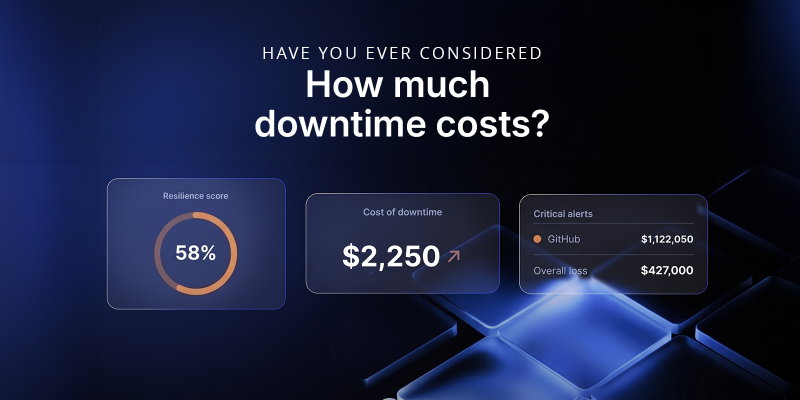
We’ve built a free downtime cost calculator so you don’t have to do this on a napkin. It applies Atlassian’s methodology to your team’s own numbers, then benchmarks the result against real incident data from the DevOps Threats Unwrapped 2026 report.
Just pick your platforms, type your team size and hourly cost, adjust how much of the day really runs through the tool, and you get your hourly figure. But that’s not all. A set of short questions designed by our security experts points out gaps in your recovery setup and assesses your current cyber resilience posture.
All within a few clicks. Calculate your downtime cost now: