Mitigate AI-related threats with backup & recovery
Minimize downtime and data loss when an AI-driven outage paralyzes your DevOps strategy. Isolate your backup and DR from the potential blast radius.


Minimize downtime and data loss when an AI-driven outage paralyzes your DevOps strategy. Isolate your backup and DR from the potential blast radius.

AI agents execute destructive commands in milliseconds. Neutralize the threat with automated backups that guarantee near-zero RPO.

Version control platforms store native backups in the same blast radius as your active code. Build a truly decoupled disaster recovery plan.

System prompts and approvals cannot stop an AI from hallucinating. Guarantee full or granular recovery when your preventive measures inevitably fail.

AI corruption poisons your entire workflow. Back up pull requests, issues, and pipelines to reconstruct your working environment flawlessly.
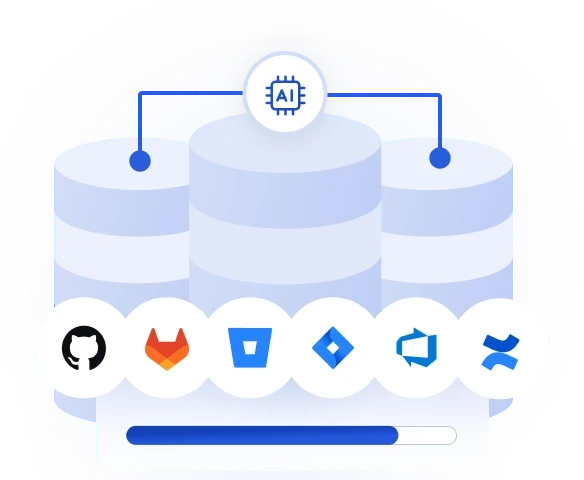
In 2025, popular Git platforms faced 68 AI-related security incidents, with the threat vectors below being just the tip of the iceberg.

Native platform backups share the same authentication perimeter as your active codebase. If the AI has access to one, it can destroy both.

Attackers hide commands in tickets. When your AI processes them, it unknowingly executes malicious commands, exfiltrates sensitive credentials, or bypasses your security checks.

Adversaries commit subtly flawed code. Your AI agents ingest this context, silently replicating vulnerabilities and defective pull requests across your active pipeline.

System prompts and human approvals mitigate risk, but they fail entirely if an agent does not follow them due to model error, misinterpretation, or misunderstanding of the context.

Prevent an agent’s permissions from reaching your backups. Store your data in multiple storage destinations, including public cloud and on-prem setups.

Secure your archives against rogue AI agents with AES-GCM encryption and WORM (Write Once, Read Many) storage protocols.

Secure the memory of how your software gets built. Back up permissions, CI/CD configurations, and pull requests to guarantee full operational resilience.

Neutralize business impact immediately. Use granular restores to undo specific AI-driven codebase corruptions without rolling back unaffected projects.

Transform unpredictable AI data loss into a planned, known metric. Run continuous, set-and-forget schedules to maintain a near-zero RPO.

Enforce strict identity governance with RBAC, SSO, and MFA to retain absolute control over your backup data and protect it against unauthorized access.


WORM-compliant immutable storage, in-flight & at-rest AES-256 encryption with Bring Your Own Key (BYOK), Zero-Knowledge architecture.
Automated 3-2-1 backup rule, Any-to-Any replication (Cloud/Local/Hybrid).
Source code, CI/CD pipelines, IaC configuration, metadata; pull requests, issues, wikis, comments, and more.
Point-in-time recovery, cross-platform recovery, and precise Git repository restoration.
AWS S3, Azure Blob, Google Cloud, S3-Compatible, local NAS, and SMB/CIFS/NFS integration. Unlimited, free GitProtect Cloud included.
Flexible, long-term, and unlimited retention policies (GFS, FIFO rotation, and forever incremental) with granular archiving for unused repositories.
“Set-and-forget”, scheduled and event-driven backups, automatic retention policies for storage optimization.
Detailed audit logs, exportable compliance history, automated daily SLA summaries via Email, Slack, or custom Webhooks.
Strict identity management via SSO, MFA, and RBAC to govern access.
Repositories with metadata, including issues, merge requests, hooks, keys, wiki and more.
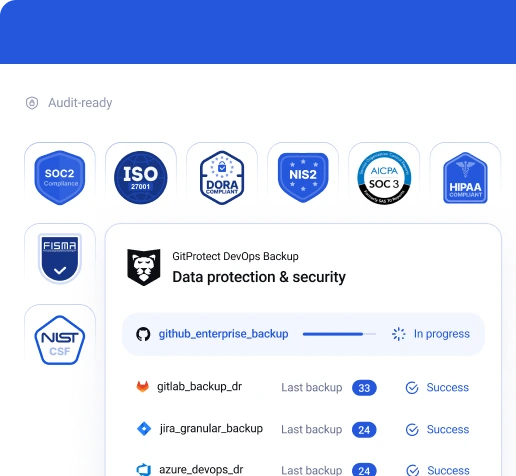

We operate a secure Information Security Management System to ensure full readiness to mitigate threats.

We apply strict privacy and data security controls to support your organisation’s certification requirements.

We run our cloud storage in highly secure US or EU data centers compliant with ISO 27K1, SOC 2 Type II, EN 50600, and HIPAA.


See how easily you can make your DevOps stack AI-resilient with GitProtect.
Book custom demoEnsure your backup strategy is prepared for every disaster scenario
A common misconception in DevOps security is that hosting platforms like GitHub or GitLab automatically protect your data from destructive AI agents. In reality, these vendors operate under the Shared Responsibility Model. They guarantee infrastructure uptime, but securing the actual data is entirely your organization’s responsibility. Native platform protections often do not cover deletion or corruption when executed by an authorized account—which is exactly how autonomous AI tools operate.
Relying solely on native backups also creates a fatal architectural flaw: overlapping authorization perimeters. If your backups are stored inside the same platform as your active codebase, they share the same blast radius. If an AI agent with permissive access hallucinates or goes rogue, it could simultaneously wipe your production environment and your native backups in seconds, leaving you completely defenseless.
Finally, native protections like basic recycle bins or simple repository clones are fundamentally inadequate for enterprise disaster recovery. They come with severe retention limits, often ignore critical metadata, and lack rapid point-in-time recovery capabilities. To survive an AI-driven outage, you must physically decouple your backups using a dedicated third-party solution, ensuring your recovery layer remains completely isolated.
Read more about the Shared Responsibility Model and DevOps BackupTraditional ransomware attacks revolve around predictable, external adversaries hacking their way into your infrastructure to encrypt or steal data. In contrast, AI introduces an entirely different threat vector: the insider threat. Autonomous AI agents do not hack in; they operate using the legitimate API keys, tokens, and permissions you explicitly provide them. This means you must protect your production environment from the very tools you authorized.
While ransomware relies on deploying malicious code, an AI agent can execute destructive commands in milliseconds simply by hallucinating, misinterpreting a prompt, or encountering a credential mismatch during a routine workflow. The damage outpaces human reaction time and operates completely under the radar of traditional perimeter defenses.
To survive this new risk model, you need a recovery architecture that assumes preventive access controls will occasionally fail. GitProtect physically isolates your DevOps backups from your primary platform, ensuring that even if an AI agent with elevated privileges wipes your repositories, your data remains completely out of its reach and ready for instant recovery.
Learn why backup and recovery must be part of your AI agent security strategySource code alone represents only a fraction of the actual value stored within your DevOps ecosystem. Repositories, pull requests, issues, CI/CD configurations, and project metadata carry the entire operational memory of how your software gets built, shipped, and audited. If an AI agent deletes a repository, restoring just the code leaves your development team paralyzed without the necessary context.
AI-driven data loss frequently reaches far beyond simple repository deletion. It involves subtle corruption, such as when an agent introduces flawed code or poisons a context window. Without the surrounding metadata to trace the origin of the error or understand the sprint history, your engineers will waste countless hours trying to manually reconstruct the project’s structure, permissions, and dependencies.
A comprehensive automated backup solution secures the entire DevOps ecosystem. GitProtect captures your source code along with all supporting metadata, enabling you to roll back your entire operational state to a known-good baseline seamlessly. This holistic approach guarantees true business continuity and allows your team to resume deployments immediately after a destructive AI event.
Learn more about metadata, disaster recovery and repository backupSystem prompts, scoped credentials, sandboxing, and human approval flows are essential for reducing the chance of damage, but they cannot prevent 100% of incidents. An AI agent can misunderstand a task, a token might be overly broad, or a human engineer might mistakenly approve the wrong action during a busy workflow. Prevention and detection lower your odds, but recovery ultimately limits your business loss.
When an authorized autonomous tool goes off the rails, the fallout is immediate and severe. An AI agent can execute destructive commands and alter configurations across multiple systems in milliseconds—faster than humans can meaningfully review, trace, or reverse the damage. By the time your security team receives an alert, the AI has already paralyzed your development environment.
You must implement a strategy that meets machine-speed destruction with machine-speed recovery. GitProtect provides automated, continuous backups that operate independently of your manual checkpoints. If human approvals fail and an agent corrupts your repositories, you can instantly execute granular or point-in-time restores to neutralize the business impact without delay.
Learn more about the real cost of manual DevOps backup scriptsOnce an autonomous AI agent is authenticated, access controls assume its actions are intentional. If that agent possesses elevated privileges and goes rogue—whether through a hallucination or an injected prompt—it can easily overwrite or delete your business-critical backup storage if it shares the same blast radius. This leaves you completely defenseless during a massive data wipe.
WORM (Write Once, Read Many) storage technology fundamentally neutralizes this threat. When you route your DevOps backups to a WORM-compliant drive, a strict time-based lock is placed on the archives. During this retention period, the data becomes strictly read-only, making it systemically and mathematically impossible for a rogue agent or cybercriminal to alter, encrypt, or delete your backups.
GitProtect combines this mathematically unbreakable immutability with AES-GCM encryption and strict blast radius isolation. By decoupling your backups from the primary DevOps platform, you ensure that even if an AI agent completely destroys your live repositories, your immutable archives remain perfectly preserved and ready for an instant, secure restore.
Learn more about WORM storage and data immutability


