How AI Automation Is Transforming Release Notes & Reports: The Complete Guide for Modern Software Teams

This article was written by experts from Amoeboids.
84% of developers currently use or intend to use AI in their daily workflows, showing that AI is no longer optional; it is necessary.
Yet, one area still stuck in the manual era is release communication. Release notes, once a simple wrap-up task, are now struggling to keep up with weekly and daily deployments.
As many product leaders have stated, “Clear releases build trust, but only when they are timely and consistent.”
Unfortunately, manual operations frequently cause delays, errors, and confusion. Now, to save you from wasting time, AI automation removes release notes and reports from the “last task” list and turns them into a built-in part of every release.
In this blog, you will explore how AI-generated release notes and reports replace manual procedures and help teams communicate updates faster and with confidence.
Why Manual Release Notes & Reports Fail at Scale
Manual release methods rarely survive expansion. What appears manageable with monthly releases quickly unravels when teams switch to weekly or daily deployments. As velocity increases, manual release notes become both a roadblock and a support system.
The work itself is repetitive and draining. Every sprint, teams go through Jira to rewrite similar updates and reformat the same information for Slack, email, and release pages. Time is spent recreating, not communicating. Mistakes happen when you are under pressure, such as missing tickets, incorrect versions, or outdated descriptions.
Consistency also takes a hit. With multiple contributors, each release sounds different. Some are crisp and clear, others rushed and confusing. Over time, this inconsistency reduces confidence.
Stakeholders lose interest when release notes and reports are delayed or unclear. Trust declines, communication deteriorates, and crucial updates are ignored. At scale, manual release notes and reports don’t just slow delivery, they quietly reduce communication and trust across teams.
What AI Automation Brings to Modern Release Management?
Release notes no longer have to be a rush job. AI automation continuously pulls, structures, and streamlines release data. It provides teams with a single and decision-ready view that simplifies approvals, keeps stakeholders aligned, and grows seamlessly across releases.
- Faster releases: AI creates release notes and reports in minutes by pulling real-time data directly from Jira and other connected tools. This eliminates manual effort and delays, ensuring that release communication is never a problem.
- Reduced errors: Automation reduces common errors like copy-paste errors, missing problems, and incorrect versions. Release Notes and Reports continue to be accurate, comprehensive, and trustworthy because data is taken directly from systems of record.
- Consistent updates: Every release has a set structure, tone, and format, despite sprint deadlines or team availability. This consistency builds trust and makes release communications easier to read and understand.
Core AI Capabilities Powering Modern Release Notes & Reports
Every AI-automated release notes and reports include a set of smart features designed specifically for software workflows.
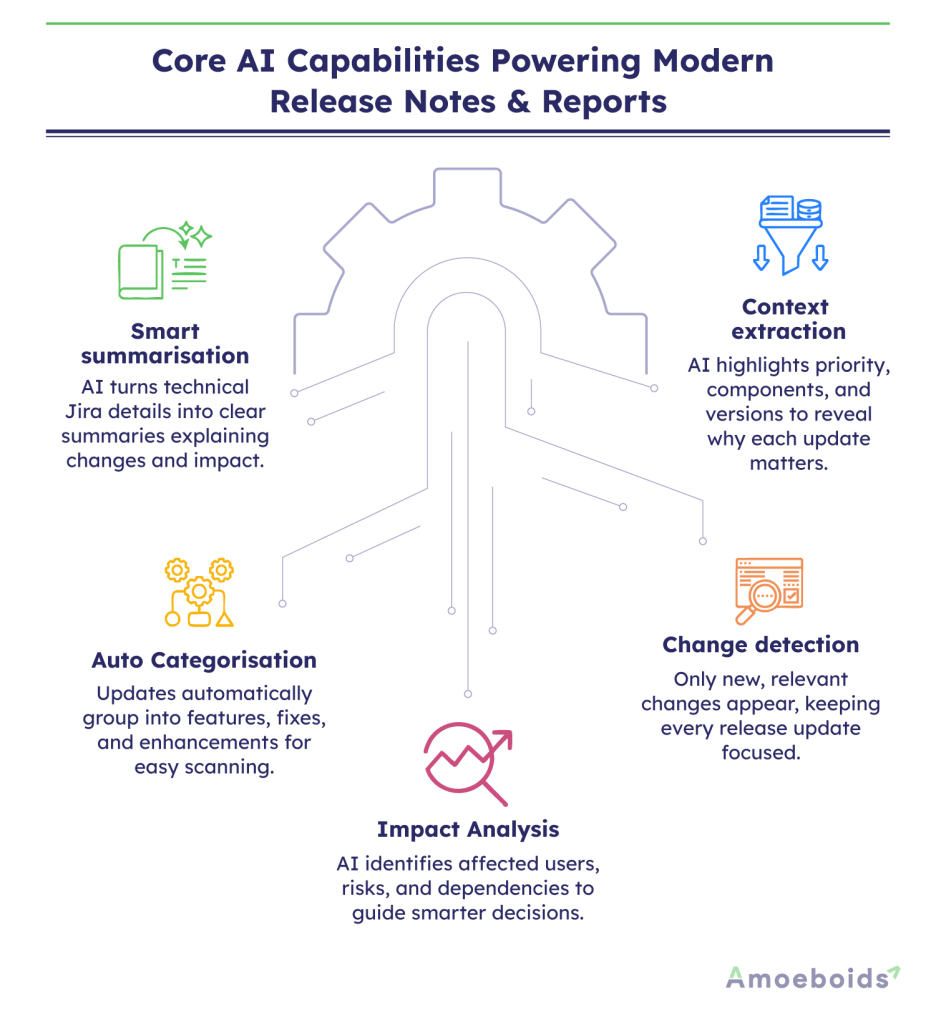
Smart summarisation
AI creates concise and readable release updates from lengthy and technical Jira descriptions. Instead of overwhelming stakeholders with raw data, it offers brief summaries that explain what changed and why it matters.
Context extraction
Not every update carries the same importance. AI automatically extracts key details such as issue type, priority, components, and release versions. It provides important context that helps stakeholders to quickly understand the significance of each change.
Auto categorisation
AI automatically divides updates into categories like bug fixes, enhancements, and new features. This reduces the need for manual tagging and ensures that release notes are structured, searchable, and easy to read. Change detection AI only detects changes made since the previous release. Filtering out duplicates and irrelevant updates keeps release notes focused, reducing noise and making each release update more meaningful.
Impact analysis
Advanced AI models evaluate potential user impacts, dependencies, and risk areas. Teams must communicate not only what has changed but also who has been affected so they can make better plans and decisions.
These capabilities work together to convert raw development data into polished release communication.
Tools Enabling AI-Automated Release Notes & Reporting
Several tools now integrate AI automation directly into release workflows, reducing manual effort and increasing consistency. Although each tool has a unique purpose, they all aim to simplify and scale release communication.
- Releasify uses AI-driven summaries to help teams create organised and clear release updates. Its goal is to simplify release communication by converting development changes into useful release notes. These are easy to understand, share, and maintain across teams.
- AI-Powered Automated Release Notes and Reports App for Jira creates clear and structured release notes and reports using Jira data and AI-driven summaries. It enables teams to reduce manual effort, maintain consistency, and seamlessly distribute release updates across multiple channels.
- Changelogit automates changelog creation for software teams. It helps to create clean, consistent, and public-facing update logs by reducing manual effort and ensuring changes are clearly and regularly documented.
- ReleaseNotes.io is an AI-powered platform that manages, publishes, and distributes release notes across multiple channels. Its automation features allow teams to reduce manual formatting, streamline publishing, and maintain unified release communication with internal and external audiences.
- Release Notes AI for Jira uses AI to generate release notes directly from Jira issues. It values speed and clarity, allowing teams to quickly convert issue data into clear release updates with little manual intervention.
How AI Automation Works in Jira-Based Workflows
Jira is heavily used in modern software delivery, making it an ideal platform for AI-driven release automation. AI starts off by identifying issues via projects, versions, sprints, labels, or JQL filters. It then checks ticket information such as issue type, status, descriptions, and metadata to better understand each change.
Based on this analysis, AI develops concise summaries, logical categories, and neat release sections. Slack, email, Confluence, and release pages are all formatted consistently with built-in templates.
Finally, release notes and reports are made available immediately to both internal and external users. It creates a streamlined process in which release communication keeps up with development without additional manual effort.
Key Benefits for Product, Engineering & Release Teams
AI-automated release notes and reports save time, improve alignment, and allow teams to deliver more confidently. Here are the main benefits that teams get when release communication is automated:
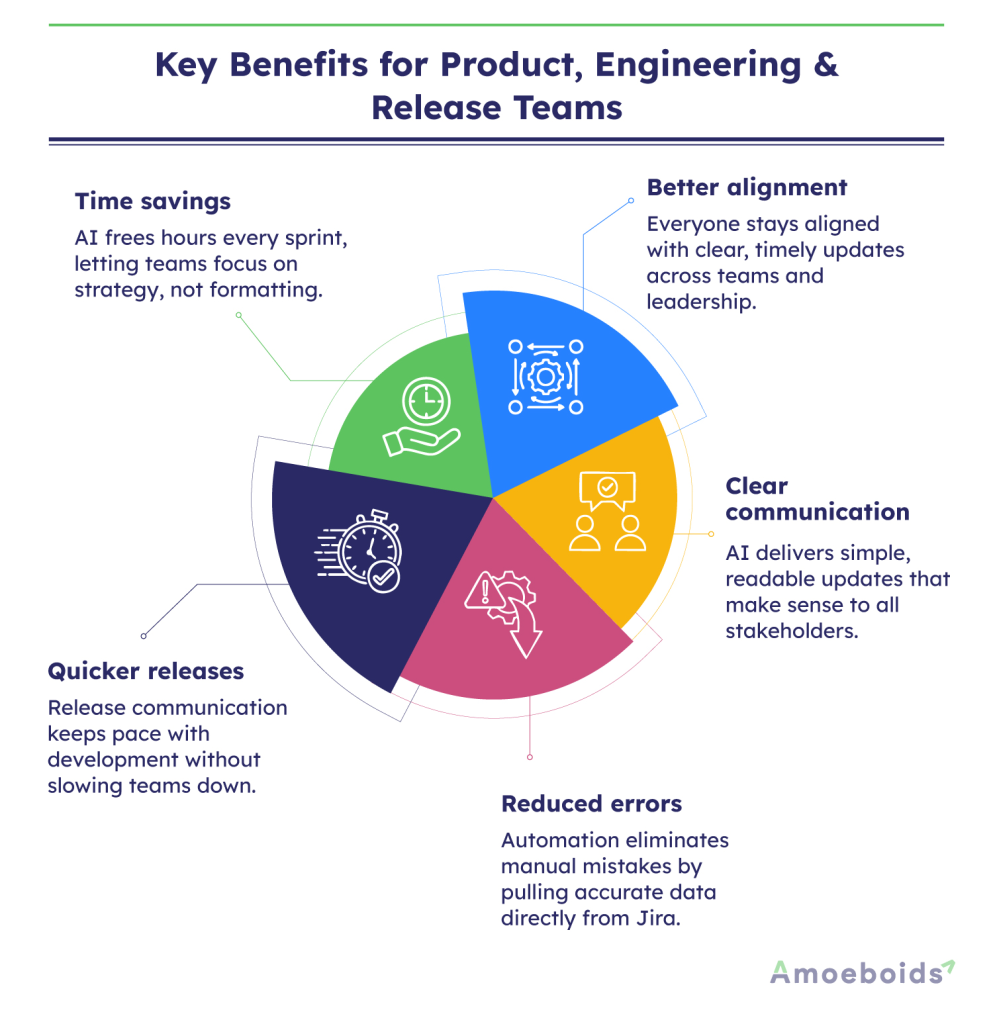
- Time savings: Teams can recover hours each sprint that were previously spent creating and formatting release notes and reports by using AI automation. This time can be used for strategic planning, quality improvements, and overall user experience improvement.
- Better alignment: Clear and timely release updates keep product, engineering, QA, support, and leadership up-to-date. Teams collaborate better, and there is less confusion because everyone knows exactly what was delivered.
- Clear communication: AI-generated release notes and reports are accurate, readable, and understandable. Even non-technical stakeholders can quickly understand what changed and why it matters without reviewing technical details.
- Reduced errors: Automation solves common problems such as miscommunication, summary errors, and missed updates. Release notes and reports remain accurate and reliable because the data is sourced directly from Jira.
- Quicker releases: Automation transforms a communication glitch into an enabler. With automatic updates, teams can enhance speed while keeping clarity and trust.
Many release managers believe that automation restores trust in the release process.
The Future of AI-Driven Release Notes & Reports for Software Teams
AI automation is still developing, and its future in release communication appears brighter. Teams are shifting toward predictive release summaries, which anticipate key highlights before a release goes live.
Release Notes and Reports will become audience-specific, with specific updates for users, executives, and internal teams. Message customisation changes tone based on impact, whereas automated pipelines reduce reliance and reduce manual intervention.
As these capabilities take shape, release notes and reports will stop being a historical record of completed releases. They will actively prepare teams and users for what comes next, making release communication more strategic and forward-thinking.
Conclusion
Release communication is often the last thing teams think about and the first thing stakeholders notice. As release cycles increase, manual procedures cause friction, errors, and silence where clarity should exist.
AI automation changes release communication into a streamlined and scalable workflow that keeps up with current developments. Trust develops when updates are accurate, timely, and consistent.
So, instead of treating release notes and reports as an afterthought, make them an integral part of each release.