Why is AES-GCM Encryption the Recommended Security Standard for DevOps Backup?

Building a resilient CI/CD pipeline means protecting every piece of data that makes your code run. Your environment variables, secret tokens, and configuration files demand the exact same security as your core repositories.
Traditional backup protocols leave these assets completely vulnerable to silent manipulation. If ransomware subtly modifies your archived backup, executing a restore will deploy the corrupted files straight into production.
Defeating these threats demands an uncompromising standard for data protection—the AES-GCM encryption.
What is AES-GCM Encryption and How Does It Differ From Older AES Modes?
Older block cipher modes, such as AES-CBC, do one job well. They grant absolute confidentiality by translating your plain text into complex cipher blocks so unauthorized users cannot read them.
But confidentiality alone leaves a dangerous gap, as making files unreadable does not guarantee that the data remains intact and unchanged over time. A locked file can still be corrupted.
The Advanced Encryption Standard (AES) evolved to face these threats by introducing the Galois Counter Mode (GCM), which delivers authenticated encryption and verifies if the data has not been secretly modified.
This upgrade fundamentally changes how you protect your encrypted data by providing two layers of defense:
- It keeps your code unreadable to unauthorized users who do not possess the encryption key.
- It simultaneously generates a unique authentication tag, ensuring the restore process immediately rejects any altered files.
By combining strong confidentiality with cryptographic integrity verification, AES-GCM encryption significantly enhances DevOps backup security.
How AES-GCM Encryption Secures Your DevOps Backup?
As hackers routinely attempt silent manipulation in supply chain attacks, as was the case with the SolarWinds backdoor malware hack, they can apply this same tactic directly to your backup storage. If you unknowingly restore manipulated files, you deploy malware directly into production.
Consequently, your entire disaster recovery strategy fails if you cannot trust the integrity of the data you restore, as it could have been altered directly inside your backup storage by a hacker.
Authenticated encryption guarantees this never happens. The GCM uses cryptographic verification to detect any unauthorized modification of the encrypted backup data.
When you initiate a restore, the system evaluates the encrypted data against its assigned authentication tag. A mismatch means the data is corrupted or poisoned.
AES-GCM helps you detect unauthorized modifications to encrypted backup data.

Read our article on the top DevSecOps Vulnerabilities That Can Compromise Your CI/CD Pipeline to build this same level of resilience across your live environments.
Can AES-GCM Slow Down Your Backup Process?
A common myth suggests that heavy encryption ruins backup frequency and recovery speed. This is no longer the case with the AES-GCM encryption.
GCM takes advantage of parallel processing and AES-NI hardware acceleration, minimizing the performance impact of encryption during backup and recovery operations.
This means you can still aim to achieve near-zero Recovery Point Objective (RPO) as well as to minimize your Recovery Time Objective (RTO) with the encryption in place.
What is more, with GitProtect, you can execute rapid cross-recovery to another platform or local drive if your cloud provider suffers a prolonged outage.
How Does AES-GCM Improve Backup Protection Against Ransomware?
Modern ransomware strains are engineered to silently infiltrate and corrupt your backup storage, turning your disaster recovery plan into a vehicle for their malware. Combating these requires a multi-layered approach to backup data security.
If your encrypted backup data is modified by ransomware, GCM gives you cryptographic assurance that the data will fail integrity verification and should not be restored.
With GitProtect, you get a dedicated ransomware protection that combines AES-GCM with immutable storage, zero-knowledge encryption, and Role-Based Access Control, ensuring you always have an integral, sealed copy of your data.
Building Cyber Resilience with GitProtect
As we’ve established, protecting your backup storage with advanced cryptography can be life-saving. That’s why GitProtect integrates AES-GCM encryption directly into its architecture.
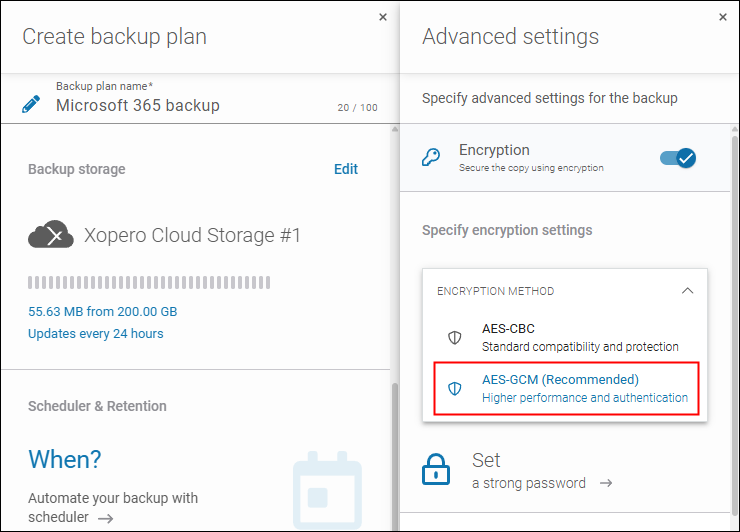
When you configure your backup plan, you simply toggle a single switch in the GUI. GitProtect natively sets AES-GCM as the recommended standard, allowing you to instantly lock down your infrastructure.
Absolute Privacy: The Zero-Knowledge Encryption
AES-GCM provides strong cryptographic protection for backup storage when implemented and managed correctly. However, it becomes useless if your encryption key gets into unwanted hands.
GitProtect eliminates this exact vulnerability by strictly enforcing a Zero-Knowledge Encryption model. The encryption algorithm executes entirely on your worker machine before initiating the transfer to your target backup destination.
You can set your own encryption key, and GitProtect has zero knowledge about it and no access to it. This ensures that no internal or external threat can ever unlock your encrypted data.
Secured Data in Bring Your Own Storage (BYOS) Destinations
When you route backups to an external destination like AWS, Azure, or a local NAS, you must operate under the assumption that the storage provider could eventually suffer a breach.
GitProtect neutralizes this third-party risk by encrypting your code in-flight and at-rest before routing it anywhere.
This gives you absolute control over your data sovereignty, which is essential in regulated industries, such as healthcare or banking, and when securing complex environments like GitHub Enterprise Cloud with Data Residency.
Encryption Key Protection with RBAC
Generating a strong encryption key is only the first step in your security strategy. You must tightly control exactly who can access those credentials to initiate a system recovery.
GitProtect solves this by embedding a Secure Password Manager directly into the platform. You store your credentials safely within this isolated key repository, keeping them hidden from unauthorized users and external threats.
Furthermore, the manager uses our strict Role-Based Access Control (RBAC) framework. This allows you to dictate precise permissions, ensuring only strictly authorized users can deploy the keys and trigger a restore of your encrypted data.
Audit-Ready Defense Mechanisms
Modern regulatory frameworks like NIS2 and ISO 27001 demand uncompromising protection, as you must definitively prove to auditors that your data remains absolutely secure both in transit and at rest.
Utilizing AES-GCM encryption natively solves this challenge. Global cybersecurity authorities, including NIST and ENISA, explicitly recommend this cryptographic standard for enterprise data protection.
Beyond strict encryption, GitProtect helps you achieve comprehensive audit-readiness by providing you with exportable activity logs, automated SLA reporting, and real-time notifications that translate into full data traceability and prove your compliance to auditors.
Secure Your Backup Integrity Before the Next Restore
Defeating sophisticated supply chain attacks requires absolute certainty that your backup archives remain untouched. AES-GCM encryption delivers that exact certainty, verifying every single byte of your infrastructure before executing a restore.
Relying on GitProtect as a trusted DevOps backup provider helps you bulletproof your infrastructure against restoring infected data into live production. It also safeguards your enterprise data from other unpredictable disaster scenarios, as supply chain attacks and ransomware are not the only threats to your repositories.
To become fully aware of the dangers your DevOps stack might be exposed to, read the GitProtect experts’ report:
📊 Uncover the Reality of DevOps Security in 2026
Our experts have thoroughly analyzed the 2025 outages, malware/ransomware attacks, and infrastructure downtimes from official status pages, security advisories, databases, and industry media.
The DevOps Threats Unwrapped Report is now available for download!
👉 Get Your Free Copy