How leadership should assess DevOps backup solutions before purchase

Managing a growing list of vendors can add complexity across an organization. Adding a new partner may require navigating additional administrative processes and internal alignment. As a result, third-party DevOps backup often ends up lower on the priority list until one serious data deletion, prolonged recovery, or failed restore turns it from a “nice to have” into an executive-level decision.
After all, DevOps backup protects the critical data and configuration assets that keep software delivery running: source code repositories, CI/CD pipelines, tool configuration, and operational context. The exact scope may vary, but the business question stays the same: what does your team need to recover in order to uphold the delivery.
Organizations address this problem in different ways. Some rely on platform-native options. Others build scripts around clone-based workflows or provider APIs. At first glance, these choices may seem simpler, especially when the goal is to avoid working with yet another supplier. But sooner or later, the trade-offs become visible.
This article does not compare every backup model in equal depth. It assumes you are already considering a third-party service and need a sharper way to separate products that look reassuring in a demo from tools that can meet your requirements under real conditions.
Executive summary
DevOps backup should be assessed as a continuity, governance, and recovery decision, not as a routine backup purchase. A vendor needs to prove backup scope, independence from the source platform, recovery speed and granularity, ransomware resilience, governance visibility, and commercial and legal clarity.
A strong buying decision depends on evidence that the solution can restore the delivery environment under real conditions and support audit, compliance, and operational control before the contract is signed.
Why DevOps backup requires a different evaluation model
Traditional backup is usually designed around infrastructure and data stores such as servers, databases, virtual machines, and user files. DevOps backup protects a different business asset: the systems, configuration, and workflows that keep software delivery running. A backup model built for infrastructure does not automatically fit DevOps recovery needs.
In this context, the issue is rarely limited to whether a copy exists somewhere. Teams often need to restore a specific repository, configuration element, or workflow dependency without disrupting the rest of the delivery process. Granular restore is therefore a part of usable recovery in a DevOps environment.
The pace of change also matters. DevOps environments rely on automation and frequent updates, which increases the cost of outdated copies, manual backup processes, and slow recovery. In environments with slower change cycles, these gaps may remain hidden longer. In CI/CD environments, they affect delivery much faster.
Scale adds another reason to assess DevOps backup differently. DevOps environments grow quickly, include many repositories and tools, and often combine cloud and on-premise components. A backup approach that works well in a narrow setup may become harder to control, recover from, or manage consistently as the environment expands.
The need for a different evaluation model becomes even clearer in SaaS environments. The shared responsibility model often creates a false sense of security. Native platform resilience can look strong while gaps remain in retention, recovery, and independence. The shared responsibility model should therefore be treated as a starting point of evaluation, not as proof that recovery requirements are already covered.
In short, DevOps backup evaluation needs to account for backup scope, independence from the source platform, recovery performance, and operational control. The mere existence of backups is not enough.
A practical evaluation framework for leadership
Most buying mistakes in this category start with generic backup criteria, too much weight on feature breadth, or too little weight on recovery proof. A stronger evaluation builds on five categories:
1. Backup scope and independence
Start by checking what the solution protects and whether that protection is genuinely separate from the source platform. Decision makers should ask for a precise answer on what is included and what is excluded. That answer should cover repository content and, where relevant, the metadata and operational context the team needs to resume work with confidence.
Independence matters just as much. If storage, control, or recovery paths depend too heavily on the production platform, an outage, account compromise, or administrative error can leave the business with fewer recovery options than expected.
2. Recovery granularity and speed
The next question is whether the team can restore the right thing, at the right level, within an acceptable timeframe. Item-level recovery, repository-level recovery, and broader recovery options solve different business problems.
Granularity affects the labor required during a restore event. Speed determines how long the pipeline is down and how much engineering capacity recovery absorbs.
Decision makers should also avoid accepting restore claims without context. Real recovery performance depends on scale, data distribution, storage design, and operating conditions. Recoverability should be validated under realistic conditions before purchase.
3. Cross-platform or cross-environment recovery
Recovery options matter more when the source platform becomes part of the problem. Outages, migrations, consolidations, and M&A events all increase the value of flexibility in restore destination.
Leadership does not need to assume every incident will require cross-platform recovery. It does need to understand whether the vendor supports recovery into another environment or provider if business conditions make that necessary.
From a business standpoint, restore-destination flexibility reduces dependency risk. It can also shorten disruption when the preferred production path is unavailable, changing, or no longer aligned with the company’s operating model.
4. Backup integrity and ransomware resilience
A backup reduces risk only if it can survive the same attack or failure that affects production.
CISA’s ransomware guidance recommends maintaining backups offline or through cloud-to-cloud approaches, because ransomware actors often try to find, delete or encrypt accessible backups.
You should verify whether a vendor can demonstrate immutability or strong tamper resistance, how deletion and retention changes are controlled, and how backup integrity is validated over time. The buying team needs proof that backup data will remain usable during an incident.
5. Governance, reporting, and policy control
Decision makers also need evidence that backup operations are visible, governed, and reviewable. That includes audit logs, SLA visibility, retention and policy controls, centralized oversight, and reporting that supports compliance or incident review.
For the CTO, this affects operational confidence. For Security and Infrastructure leadership, it affects audit readiness, accountability, and the ability to review health and exceptions without relying on tribal knowledge.
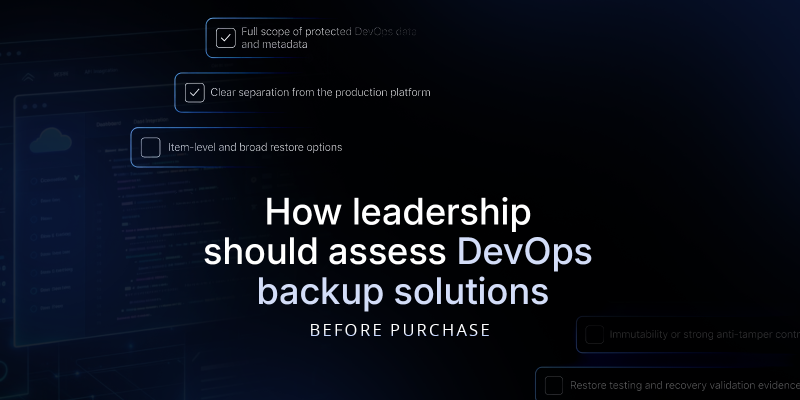
DevOps backup solution assessment checklist
To assess a DevOps backup solution, ask the vendor to demonstrate:
- Full scope of protected DevOps data and metadata
- Clear separation from the production platform
- Item-level and broad restore options
- Realistic and documented recovery expectations
- Cross-platform or cross-environment recovery paths
- Immutability or strong anti-tamper controls
- Restore testing and recovery validation evidence
- Audit logs, SLA visibility, and failure notification
- Retention and policy controls
- Secure access and admin controls
How to assess vendor trustworthiness
A backup vendor deserves scrutiny beyond product claims. Security posture is a core part of that review, alongside commercial clarity and legal fit.
Start with control maturity. AICPA describes a SOC2 examination as a report on controls relevant to security, availability, processing integrity, confidentiality, or privacy. ISO/IEC 27001 defines requirements for an information security management system. Both are useful trust signals, when you understand their scope and limits. They show that a vendor operates with formal controls. They do not prove product fit or restore quality on their own.
Then look at commercial clarity. The buying team should understand the full cost model before signing the contract. That includes storage growth, restore-related fees, paid add-ons, support-tier dependencies, and any charges tied to retention, egress, or advanced recovery workflows. A complicated pricing model can weaken the business case even when the product looks strong.
Legal and compliance fit require the same attention. That includes data residency, DPA terms, subprocessor transparency, retention and deletion rules, contract exit terms, and data portability. In regulated environments, these details can affect audit readiness, procurement timelines, and platform choice.
Due diligence artifacts and proof points to request before buying
Once a vendor looks credible, the next step is to request the materials that confirm the claims and validate the solution before final approval.
| Artifact | Purpose |
| SOC 2 Type II report | Check whether relevant controls were tested over time. |
| ISO 27001 certificate and scope statement | Confirm that the certification covers the service and operating scope relevant to your use case. |
| Penetration test summary or attestation | Verify the recent external security testing has been completed. Request a date within the last 12 months. |
| Product architecture diagram | Review backup separation, storage design, and control points. |
| Immutability documentation | Confirm how tamper resistance is enforced and who controls it. |
| Data flow and data residency documentation | Review where data is stored, processed, and transferred. |
| Restore test evidence or recovery validation evidence | Confirm that recovery has been tested in practice. |
| Audit log samples or reporting examples | Confirm operational visibility before purchase. |
| SLA and support policy documentation | Understand response times, escalation paths, and recovery expectations. |
| Disaster recovery or business continuity summary | Review the vendor’s own resilience posture. |
| DPA and subprocessor list | Confirm privacy obligations and third-party data handling. |
| Incident response summary | Understand notification and escalation expectations. |
| Retention, storage, and exit policy documentation | Clarify cost structure, data portability, and lock-in risk. |
Missing, vague, or delayed materials should be treated as buying risk before legal review.
What a strong buying decision looks like
A strong buying decision in this category depends on proof of recoverability, governance, resilience, and cost clarity before the contract is signed.
By the end of evaluation, decision makers should be able to answer three questions with confidence: Can we recover the right data? Can we recover it under the conditions our business worries about? Can we prove control, accountability, and commercial clarity before purchase?
That is the standard worth using. It keeps the decision grounded in continuity outcomes and verifiable evidence, not vendor reassurance.
Want to see how these criteria map to a real product?
Book a demo to see how GitProtect delivers independent recovery, audit visibility, and stronger backup control.